Standard Bots raises $200M at a $1 billion valuation with Amazon and Samsung in the round, targeting 10 percent of all new U.S. industrial robot deployments
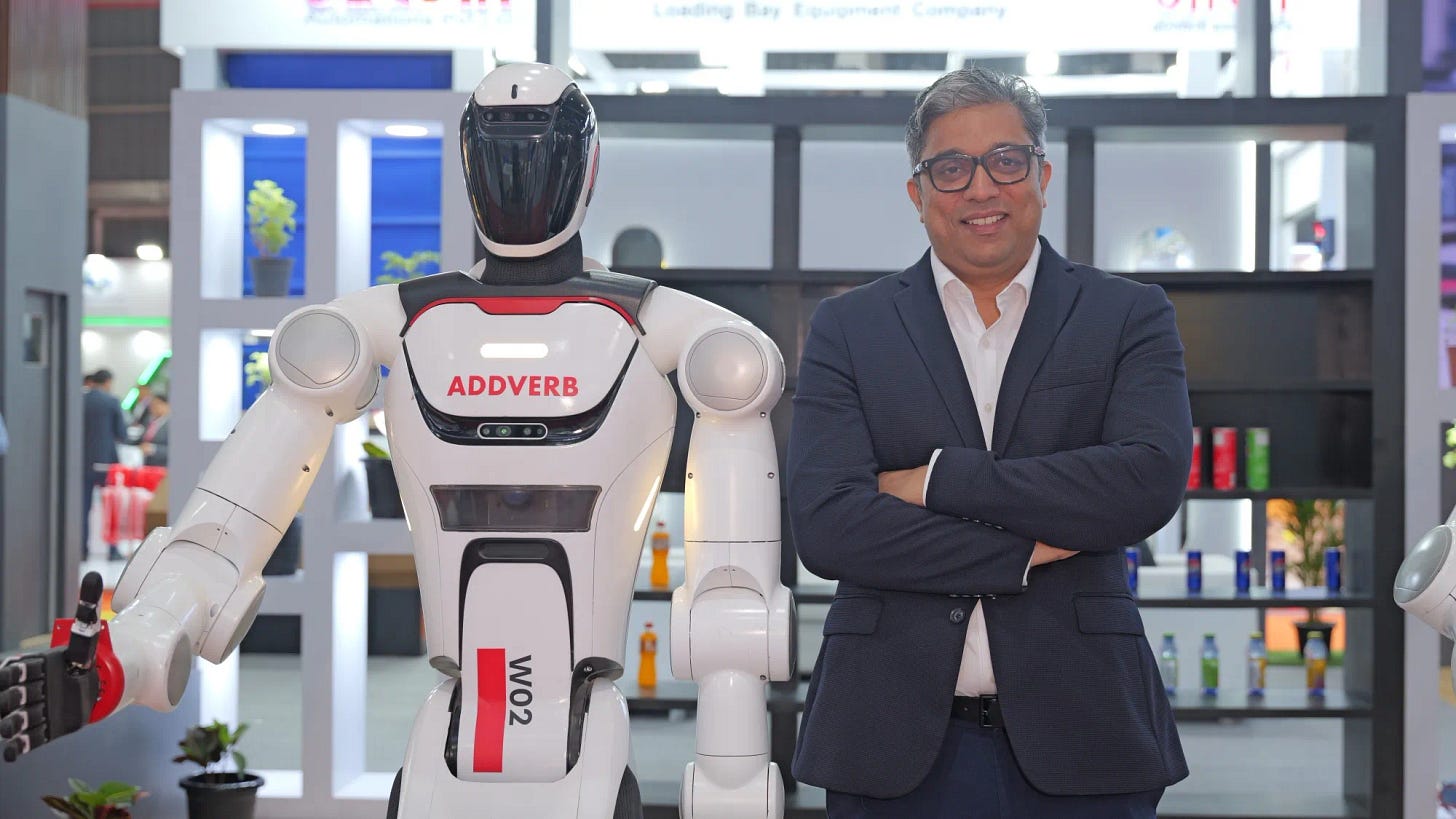
Standard Bots, the Glen Cove, New York-based industrial robotics company, has closed a $200 million Series C at a $1 billion valuation, co-led by General Catalyst and RoboStrategy with participation from Amazon, Samsung Next, Box Group, and GiantLeap Capital. The company develops AI-native 6-axis collaborative robotic arms and industrial humanoids built on Nvidia’s Isaac physical AI stack, and says it is on track to handle 10 percent of all new industrial robot deployments in the United States.
The funding will go toward expanding the company’s New York manufacturing facility to 70,000 square feet, scaling its vertically integrated production process, and accelerating engineering hiring. Standard Bots is co-founded by CEO and Chief Engineer Evan Beard alongside David Golden and James Cordle. The client list already includes Lockheed Martin, NASA, Sunoco, and the U.S. Army, which puts the company inside both enterprise manufacturing and defense procurement pipelines at a stage where most robotics startups are still working through their first handful of commercial deployments.
The technical approach is worth noting because it directly addresses one of the most persistent adoption barriers in industrial robotics. Standard Bots’ system allows operators to teach robots manufacturing tasks through manual demonstration rather than code, which removes the programming bottleneck that has historically required specialist integrators every time a robot needs to learn a new task or adapt to a changed workflow. Running on Nvidia’s Isaac stack gives the platform a foundation model layer for perception and manipulation, while the vertical integration of hardware manufacturing in New York means the company controls the full pipeline from production through deployment. At a $1 billion valuation with Amazon and Samsung on the cap table, Standard Bots is being priced as an infrastructure bet on the next phase of American industrial automation rather than a single-product robotics company.
Mach Industries raises $300M at a $1.8 billion valuation with six autonomous vehicles in development, a DOD contract for a seventh, and its own rocket motor supply chain locked in
Mach Industries, the Huntington Beach, California-based defense tech startup founded in 2023 by MIT dropout Ethan Thornton, has closed a $300 million Series C at a $1.8 billion valuation, nearly quadrupling its valuation from the $470 million mark set during its $100 million raise in June 2025. The round was led by Infinite Capital and Ribbit Capital, with participation from Bedrock Capital, Sequoia Capital, and Khosla Ventures. The company initially set out to raise $200 million, was heavily oversubscribed at that target, pushed to $300 million, and remains oversubscribed at the higher figure.
The product pipeline is where the story gets interesting. Mach currently has five autonomous vehicles in development: Viper, a jet-powered vertical takeoff vehicle; Glide, a high-altitude glider that can launch weapons; Stratos, an airborne surveillance platform; Dart, a low-cost counter-drone interceptor; and Pike, built for long-range munitions. Production is expected to begin on at least three of these systems next year. This week, the company also won a Department of Defense contract through the Defense Innovation Unit to develop a sixth vehicle it has never discussed publicly, described as a runway-independent strike aircraft for the Navy. Thornton told TechCrunch the aircraft will be large and could have commercial applications as well.
The acquisition of Exquadrum, a solid rocket motor startup, for $50 million in cash and equity last month is the move that arguably gives Mach its most durable competitive advantage. There is an acute shortage of solid rocket motors globally as drone demand has created unprecedented pressure on a supply chain controlled almost entirely by two legacy prime contractors, Aerojet Rocketdyne and Northrop Grumman, with lead times stretching years. By bringing SRM production in-house, Mach controls its own propulsion supply chain and has simultaneously launched a commercial business called Mach Energetics to sell motors to other companies. The current revenue mix sits at roughly 50/50 between government sales and commercial customers.
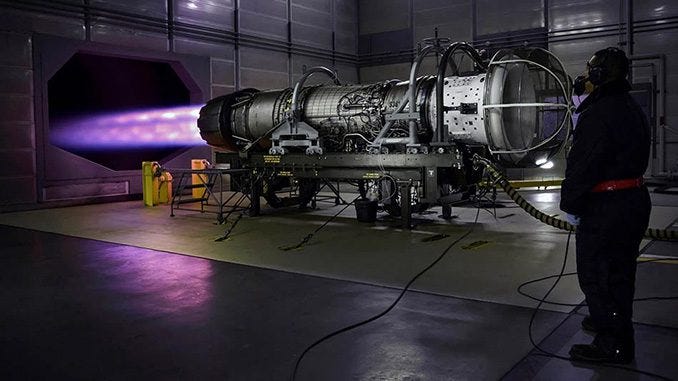
The company has grown from around 12 employees in its first year to approximately 350 today, operates a 115,000 square foot manufacturing facility in Huntington Beach, and plans to bring four additional production facilities online by the end of 2026. Thornton, who is 22, highlighted the speed of product development as the company’s defining trait, noting that his team went from no team to a jet engine firing in about eight months, compared to the roughly four-year timelines typical in the defense industry. That pace of execution, combined with the Exquadrum acquisition and a growing contract pipeline, is the core of the investor thesis behind this round.
OpenAI relaunches an internal robotics division four years after shutting down its original team, with hiring underway for a vertically integrated hardware operation in San Francisco
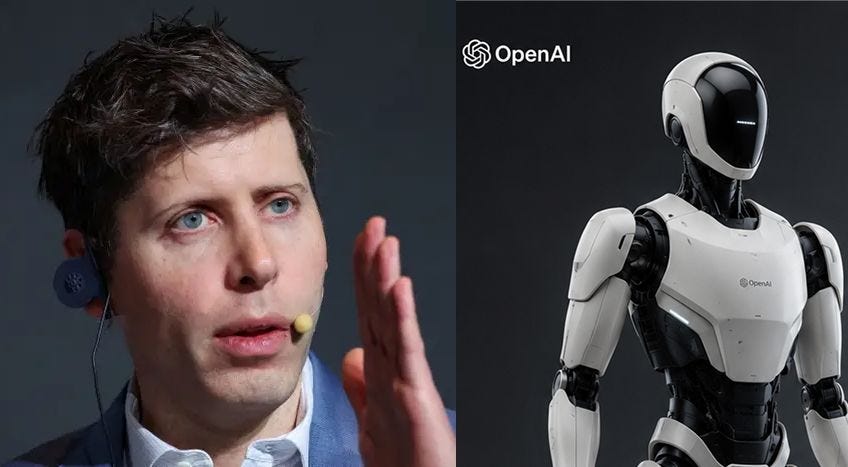
OpenAI has formally restarted its robotics program, four years after shutting down the original division in July 2021. CEO Sam Altman announced the effort on May 31, calling for engineers across hardware, ML, and operations to help build robots for physical infrastructure work. The new unit, called OpenAI Robotics, grew out of the company’s world simulation research program led by Aditya Ramesh, the researcher behind DALL-E. Altman described the evolution as rapid, with progress built on co-design between robotics hardware and machine learning research rather than treating them as separate workstreams.
The hiring profile tells the story of what OpenAI is actually building. The company has listed 11 specialized roles in San Francisco, including a custom actuator design engineer focused on torque density and thermal architecture, a simulation realism engineer working to close sim-to-real gaps using physics engines like MuJoCo, and an operations manager for large-scale data acquisition managing workforce and fleet infrastructure. A 3D printing lab technician, DAQ station engineer, and electrical engineer are also on the list. That spread covers hardware design, simulation, manufacturing tooling, and operational scale, which signals a vertically integrated robotics operation rather than the partnership-driven model OpenAI had been running through minority investments in Figure AI and 1X Technologies.
The Figure AI relationship has already fractured over this. Figure CEO Brett Adcock publicly said Figure dropped OpenAI after learning about the internal robotics push, claiming his AI teams outperform OpenAI on physical hardware. The split highlights a tension that will play out across the industry as AI companies move from investing in robotics startups to competing with them directly. OpenAI now sits alongside Tesla’s Optimus program, Figure, 1X Technologies, Physical Intelligence, and Meta’s robotics efforts in a field that barely existed as a competitive category two years ago.
The near-term focus is infrastructure construction, specifically supporting the crews building data centers, power grids, and factories, where labor shortages have become acute as AI-driven demand accelerates buildout timelines. The longer-term vision is broader, with Altman describing a future where personal robots become as common as personal devices. The team has also absorbed talent from the discontinued Sora video generation project, which makes technical sense since world simulation models that predict how physical environments behave are directly applicable to training robots in virtual environments before deploying them in the real world. OpenAI has not disclosed delivery timelines, manufacturing partners, or a dedicated hardware budget. What is clear is that the company now views robotics as central to its AGI mission rather than a peripheral bet to be outsourced through portfolio investments.
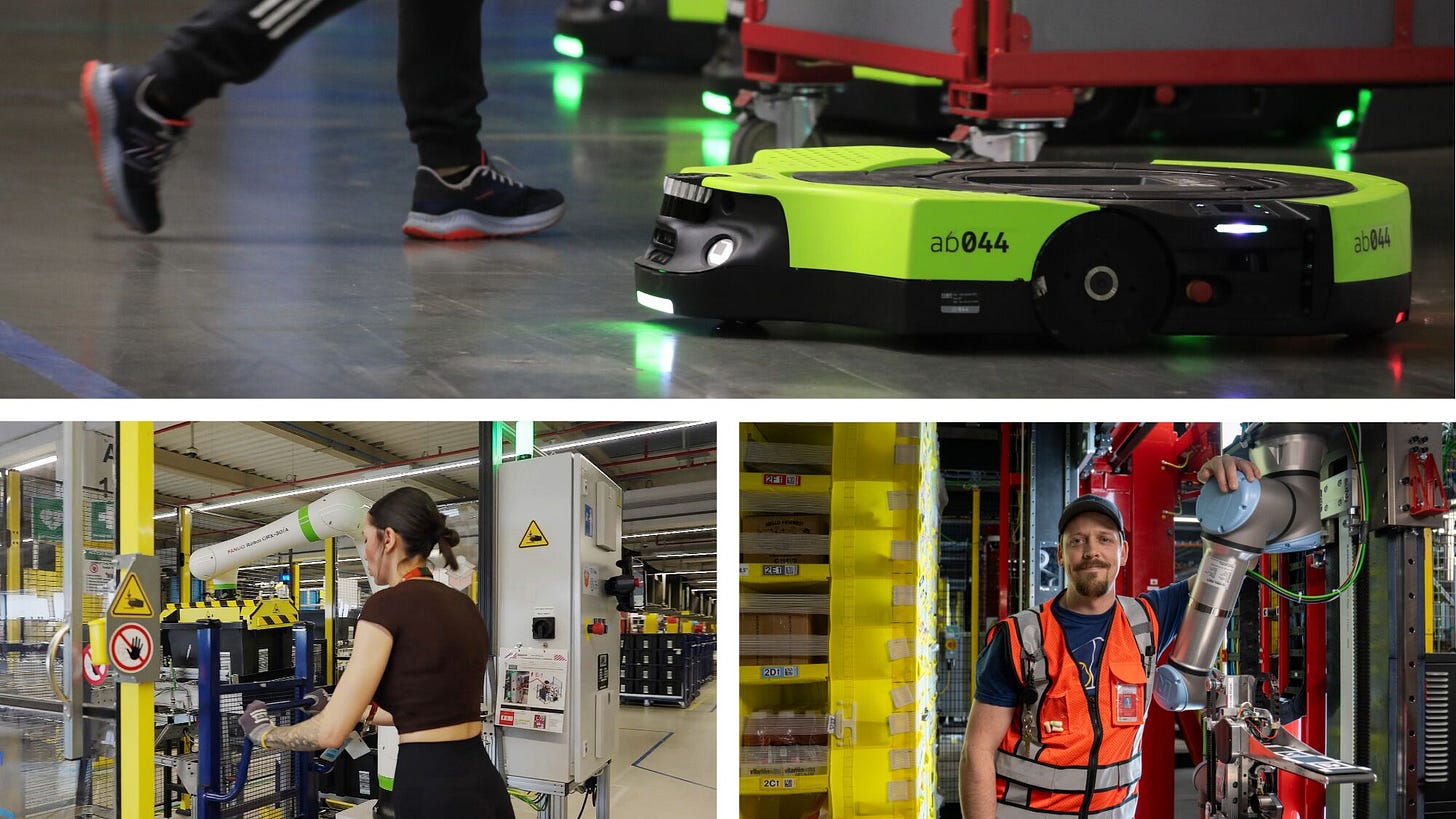
Amazon announces $10 billion European fulfillment expansion with three new robot systems, as its deployed fleet crosses one million units
Amazon has committed more than $10 billion to expand and modernize its European fulfillment network, with plans to deploy three new robotic systems and grow its regional workforce by 25,000 by the end of the decade. The investment comes as the company’s total deployed robot count has crossed one million units globally, a milestone that makes Amazon by far the largest operator of warehouse robotics in the world.
The headline product from the London announcement is the next-generation Proteus, Amazon’s first fully autonomous mobile robot. The original Proteus, introduced in 2022, was limited to dock areas where it moved heavy carts short distances. The updated version can operate anywhere in a fulfillment center, transporting containers from arrival through to workstation transfers and outbound loading. The most significant change is how workers interact with it. Proteus now understands plain conversational language, meaning warehouse employees can assign tasks the way they would talk to a colleague rather than through programming interfaces or technical commands. Scott Dresser, VP of Amazon Robotics, described it as an assistant for material movement that figures out priority, route, and timing on its own. Proteus 2.0 is currently in lab testing, with European deployment expected in the first half of 2027.
Alongside Proteus, Amazon introduced STARK, a collaborative robotic tote-handling system designed by an operations employee, which picks full totes from conveyors and places them on carts to eliminate repetitive heavy lifting. First piloted in Barcelona, STARK is planned for 15 European sites by 2027. The company is also expanding deployment of Vulcan, its first robot with a sense of touch, which uses sensors to simultaneously see and feel objects while determining how much force to apply. Vulcan already handles complex picking tasks at Amazon’s Hamburg facility and will be installed at additional sites. These two systems sit alongside an existing fleet that includes Hercules and Titan drive units, Sparrow and Robin robotic arms, Cardinal for package loading, and Sequoia for AI-driven inventory consolidation, all of which are already running across Amazon’s network.
The workforce question around this expansion is the one Amazon continues to navigate publicly. The company maintains that robotics has not cost jobs and points to hundreds of thousands of hires made since introducing automation. However, the Wall Street Journal reported last year that Amazon has fewer employees per facility than at any point in the past 16 years, and CEO Andy Jassy has said the company will need fewer employees over time because of AI. The $10 billion European investment and 25,000 new roles are real numbers, but the trajectory of the underlying ratio between robots and humans per facility is moving in one direction, and the introduction of natural language task assignment in Proteus only accelerates that shift by removing one of the last remaining friction points between human supervisors and autonomous systems.