
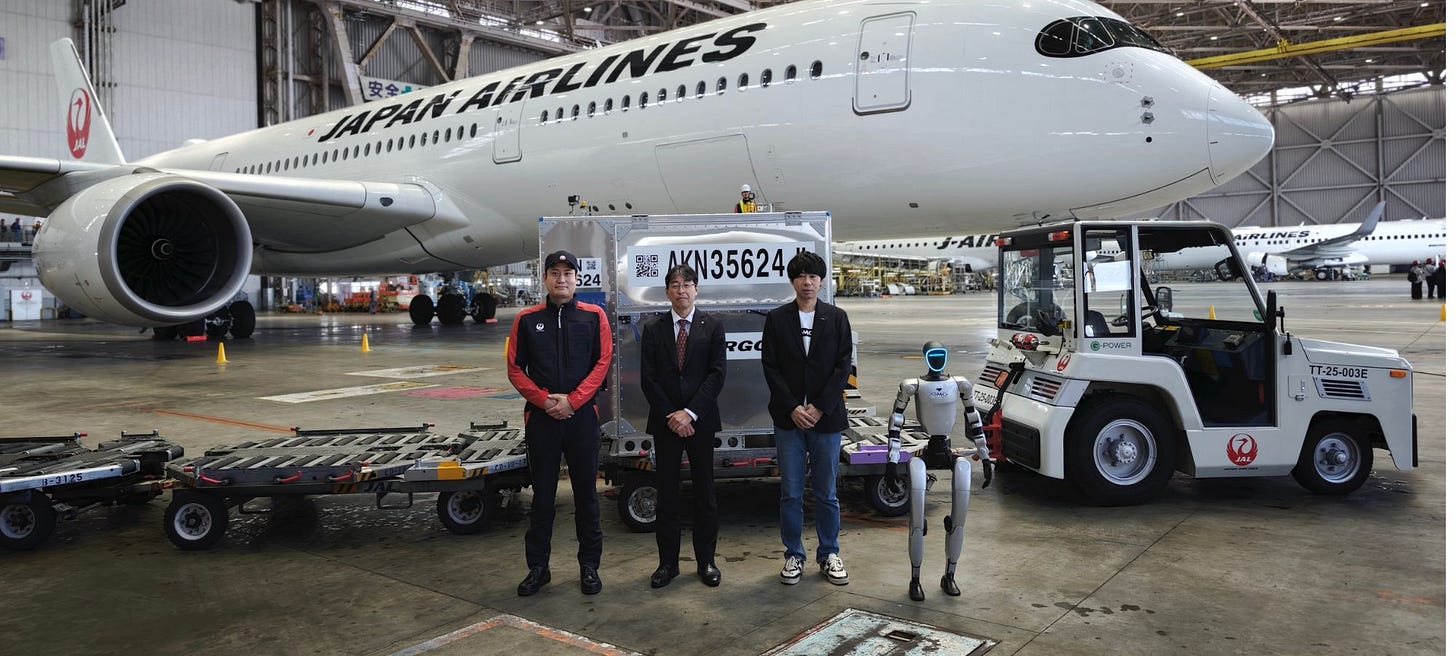
JAL Ground Service and GMO AI & Robotics launch Japan's first humanoid robot demonstration for airport ground handling operations!
Japan Airlines’ ground handling arm, JAL Ground Service, and GMO AI & Robotics Corporation have begun a joint demonstration project to test humanoid robots in airport operations, marking the first initiative of its kind in Japan. The project launched in May 2026 and is structured as a mid-to-long-term phased verification rather than a short-term pilot, starting with operational analysis to identify where humanoid robots can be safely introduced, followed by repeated simulations of real airport conditions before any full deployment.
The case for humanoid form factors here is specific rather than aspirational. Airport ground handling environments are built around human workers operating varied ground support equipment in tight spaces around aircraft. Conventional fixed automation and single-function robots have consistently struggled to adapt to these layouts without significant infrastructure changes. A humanoid robot, by contrast, can be introduced into existing facilities and aircraft structures without modification, which lowers the practical barrier to deployment considerably. Tasks on the longer-term roadmap include baggage loading, cabin cleaning, and operating ground support equipment directly.
The labour context behind the project is worth understanding. Japan’s aviation industry is facing a structural shortage of ground handling personnel driven by two converging trends: rising inbound tourism pushing operational demand upward, and a shrinking working-age population reducing the available workforce. Ground handling roles carry both high skill requirements, including aircraft marshalling and cargo handling, and significant physical demands, making them difficult to fill and retain staff for over time. The humanoid robot program is framed as a response to that specific pressure rather than a general automation exercise.
JAL Ground Service brings operational knowledge of live airport environments, and GMO AI & Robotics contributes the AI and robotics technology stack. The collaboration is structured around each company contributing what the other cannot easily replicate independently. The ultimate objective is a sustainable operational model where humanoid robots handle physically demanding or repeatable tasks alongside human workers, reducing workload without replacing the skilled judgment that airport ground operations still require. No deployment timeline beyond the current demonstration phase has been disclosed.
Mind Robotics crosses $1 billion in total funding after a $400M round led by Kleiner Perkins, with Rivian as a live manufacturing partner and key shareholder!
Mind Robotics, the Palo Alto-based industrial robotics company founded by RJ Scaringe in 2025, has closed a $400 million financing round led by Kleiner Perkins, pushing its cumulative funding past $1 billion in under a year. The round drew in a broad syndicate of new investors including Meritech Capital, Redpoint Ventures, SV Angel, Incharge Capital, A-Star Capital, and Garuda Ventures, alongside continued participation from existing backers Accel, Andreessen Horowitz, Eclipse, Prysm Capital, Bain Capital Ventures, and Greenoaks. This follows a $115 million seed round in late 2025 and a $500 million Series A closed in March 2026, making the capital accumulation timeline one of the more aggressive seen in the robotics sector.
The company is building a full-stack industrial robotics platform that combines foundation models, purpose-built hardware, and deployment infrastructure aimed at automating dexterous, reasoning-intensive manufacturing tasks. What gives Mind Robotics a structural advantage over most companies pitching in this space is its relationship with Rivian, which operates as both a key partner and a shareholder. Rivian provides a live, high-volume manufacturing environment for model training and real-world deployment, which addresses one of the most persistent problems in industrial robotics: access to the kind of messy, variable, production-scale data that controlled lab environments cannot replicate.
The investor framing around this round is worth noting. Kleiner Perkins partner Ilya Fushman described general-purpose robotics as converging toward viability through simultaneous advances in models and hardware, and positioned Mind Robotics as having access to all the components required to make that work in real manufacturing environments. That framing reflects a broader shift in how top-tier venture capital is thinking about the robotics category, less as a hardware bet and more as a platform play where the foundation model layer, the physical deployment infrastructure, and the live training environment all need to exist together before the system can generalize at scale. Mind Robotics is one of the few companies at this stage that can credibly claim all three.
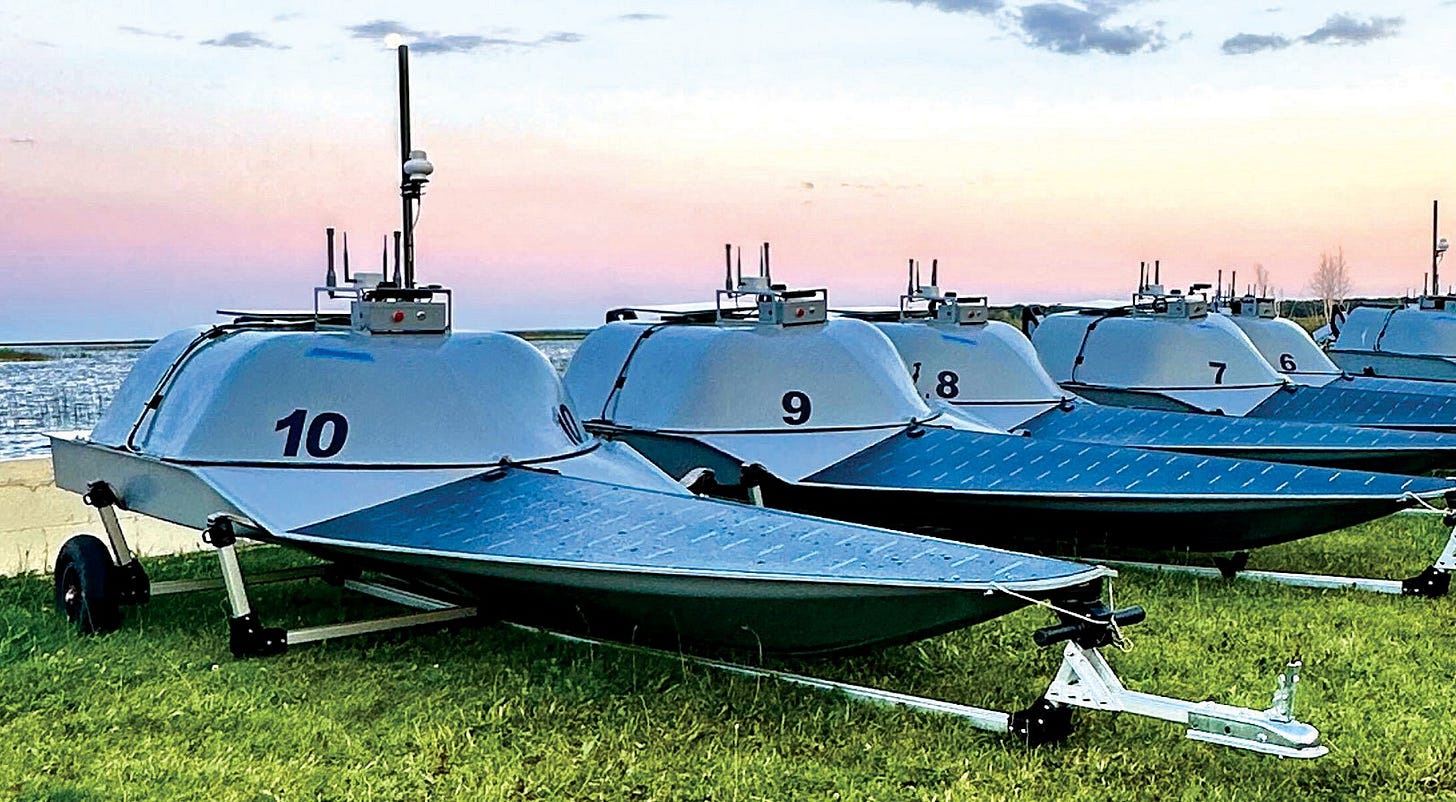
Havoc closes a $100M Series A to scale collaborative autonomy software across air, sea, and land platforms, bringing total funding to $200 million since 2024!c
Havoc, the all-domain collaborative autonomy company, has closed a $100 million Series A round bringing its cumulative funding to roughly $200 million since launching in 2024. New investors in the round include CCM Capital Markets, Clear Street, Cobalt Capital, Boardman Bay Capital Management, Meet Perry, Mute Ventures, Soren Ventures, SAIC, and JA Green. Existing backers Outlander VC, Scout VC, B Capital, Lockheed Martin, Taiwania Capital, UP.Partners, and The Veteran Fund all participated again, alongside Vanderbilt University’s endowment. The breadth of the syndicate, spanning venture capital, defense primes, and an institutional endowment, reflects how wide the investor appetite for defense autonomy has become.
The problem Havoc is building around is not hardware. The capability to manufacture drones, autonomous surface vessels, and ground vehicles exists across a growing number of vendors. What has not been solved is getting thousands of those heterogeneous autonomous assets to operate together as a coordinated force across domains, particularly in environments where communications are degraded, distributed, or actively contested. Havoc’s approach is software-defined, meaning its collaborative autonomy stack runs across existing platforms rather than requiring purpose-built hardware, which lowers the barrier to deployment considerably.
The company says its software is already running across more than 100 air, surface, and ground platforms, which puts it ahead of most defense autonomy startups that are still operating in controlled demonstration environments. CEO Paul Lwin framed the core capability as enabling a single warfighter to task, monitor, and supervise thousands of heterogeneous autonomous systems operating together, a command ratio that current human-in-the-loop systems cannot approach. With SAIC now in the cap table alongside Lockheed Martin, Havoc has two of the defense industry’s largest systems integrators carrying a financial stake in its success, which matters for procurement pathways into programs of record. The Series A will go toward accelerating deployment across all three domains as the company moves from demonstrated capability toward fielded systems.