
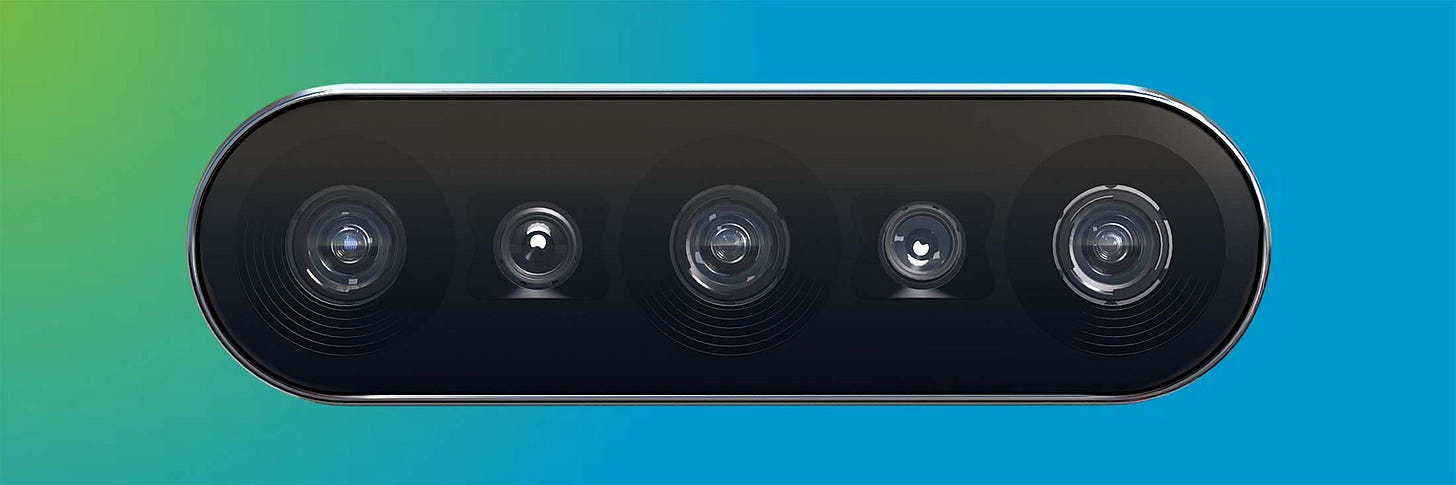
RealSense drops the D585 Pro, an AI-native depth camera that ships with on-device inference and gets smarter through software updates
Three years ago, Intel tried to kill RealSense. In August 2021, the company announced it was shutting down the division to refocus on core businesses, a decision that caught even internal RealSense leadership off guard. Intel reversed course quickly, kept the team alive with a stripped-down product lineup, and then in July 2025 finally spun RealSense out as an independent company with $50 million from Intel Capital and MediaTek’s innovation fund. That history matters because the D585 Pro, announced this week at Automate 2026, is the first product that fully reflects what RealSense can build when it is no longer operating inside a chip company that was never quite sure what to do with it.
The spec sheet is dense, but a few numbers stand out. Sub-15 centimeter minimum range at full resolution, which RealSense says is 2.5x better than the nearest competitor. 120 by 100 degree field of view at 60 frames per second, double the frame rate of the 30 FPS class it is replacing. 10 meter-plus operating range for warehouse and factory navigation. IP65 dust and water protection on every unit, no premium SKU required. And more than 2x better depth quality than the previous RealSense generation across the full field of view. The camera targets humanoids, AMRs, cobot arms, industrial robotics, and inspection systems.
What actually differentiates the D585 Pro from a typical depth camera upgrade is the architecture underneath. The camera runs on a custom Gen 5 system-on-chip that packs a depth engine, image signal processor, digital signal processor, dedicated AI accelerators, and a quad-core ARM processor into a single device. That means depth processing and AI inference run directly on the camera at the edge rather than consuming host compute resources. At launch it ships with enhanced depth processing and person detection in beta, both running entirely on-device. Planned SDK updates will add visual-inertial odometry, occupancy grid generation, auto-calibration, and face detection to existing hardware after general availability, no swap required.
RealSense CEO Nadav Orbach called the D585 Pro “the actualization of the Visual Cortex of Physical AI,” which is a marketing line, but the underlying product logic is real. A software-defined camera that improves over time through SDK updates rather than hardware replacements changes the purchasing calculus for robotics teams that would otherwise need to rip and replace perception hardware every cycle. Dual RGB streaming at 30 FPS with synchronized depth data opens up use cases in digital twins, inspection pipelines, and humanoid vision stacks that previously required multiple sensor setups. Shipping is expected Q1 2027, with the RealSense Perception Studio beta available this month for registered developers.
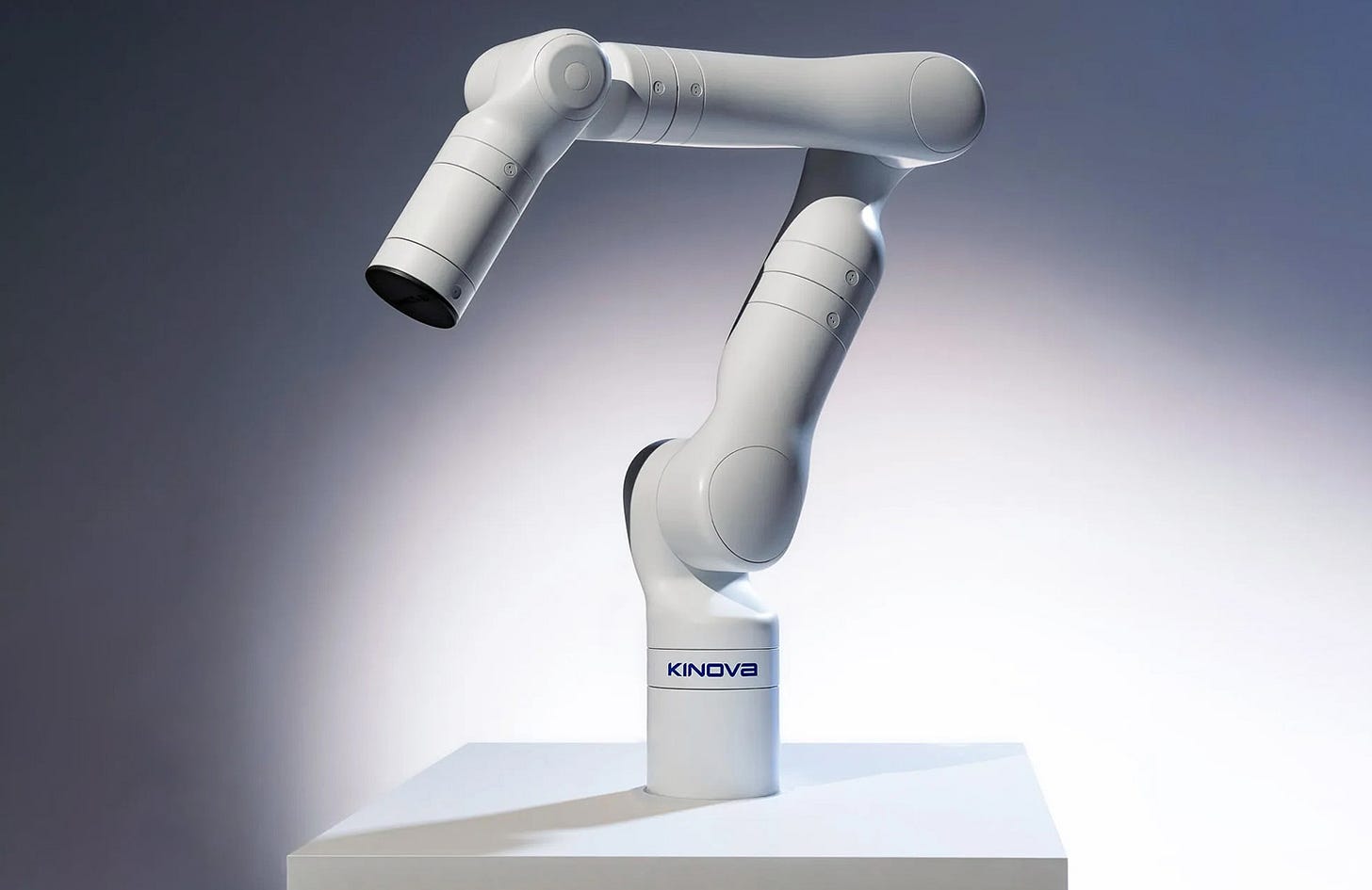
Kinova turns 20 and launches KIMA, a medical robotic arm built for the operating room from scratch rather than retrofitted from industrial hardware
Most medical robotic arms on the market started life as industrial robots. Companies take an existing platform, add safety certifications, clean up the form factor, and sell it into clinical environments. Kinova went the other way. KIMA was designed from the ground up for medical use, with IEC 62304 Class C software and ISO 14971 safety standards built into the architecture natively rather than bolted on after the fact. That is a meaningful distinction when the arm is operating inside a patient.
The hardware reflects that priority. Under 13 kilograms total weight with a 3 kilogram payload class, no external control box, redundant torque sensors in every joint, and a form factor engineered specifically for the space constraints of modern operating rooms where multiple robots, devices, and clinical equipment already compete for floor and ceiling real estate. Kinova is targeting applications across endoscopy, bronchoscopy, and complex surgical interventions.
A few details worth pulling out:
Open architecture running EtherCAT communication protocols in a controller-less design, which means direct control and easier integration into existing medical platforms
Instrument drives with power and passthrough I/O for connecting surgical instruments and devices directly
Technology partner network including QNX, RTI, MedAcuity, MPE, and Acontis to reduce integration complexity for teams building on top of the platform
That last point matters because Kinova is positioning KIMA as a modular platform rather than a finished product. The pitch is aimed at both startups and established medtech companies looking to build clinical solutions without engineering a robotic arm from zero. Last year, Kinova partnered with Bota Systems to integrate force-torque sensing into its Gen3 manipulator for closing the sim-to-real gap, which gives some indication of the broader research ecosystem the company is plugged into.
Kinova has been building assistive and collaborative robots out of Boisbriand, Quebec since 2006. Twenty years in, KIMA is the clearest statement the company has made about where it sees its next chapter heading. Whether surgical robotics incumbents treat KIMA as a serious competitive entry or as an OEM platform they can build on top of will say a lot about how the medical robotics supply chain evolves from here.
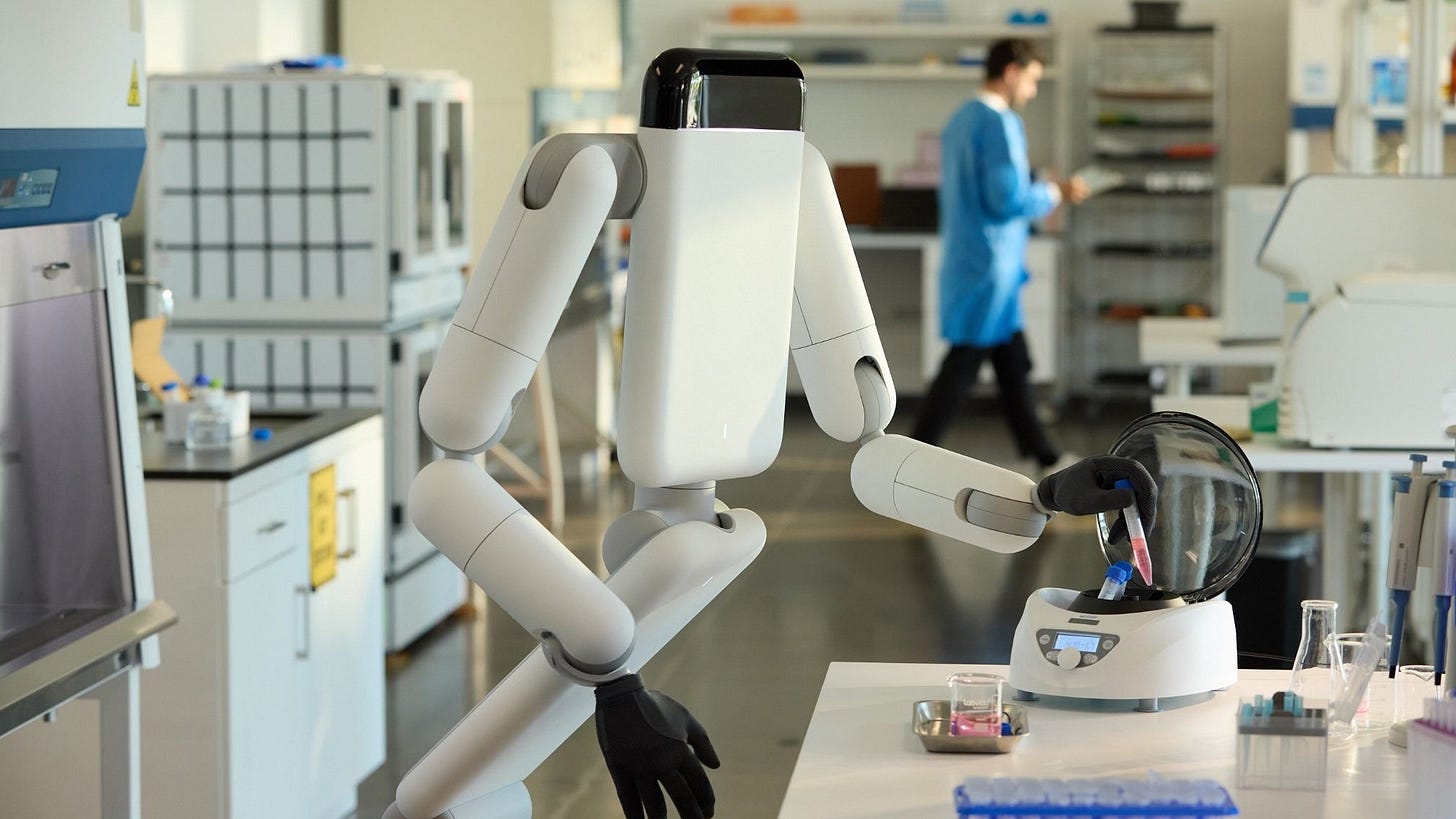
Genesis AI raises $105M and launches Eno, a wheeled two-armed robot that bets the next wave of general-purpose robotics does not need legs, a head, or a face
Everyone in robotics right now is building a humanoid. Figure, Tesla, Agility, 1X, Boston Dynamics, Unitree, AGIBOT, the list grows weekly. Genesis AI looked at that consensus and decided it was wrong. Eno, the company’s first complete robot system, has two arms, proprietary dexterous hands, a wheeled base, and an adjustable panel body that can raise, lower, and fold for storage. No legs. No head. No face. The argument is simple: a robot can use human tools and operate in human spaces without pretending to be human.
Genesis was founded in 2025, raised $105 million from Eclipse, Khosla Ventures, and Eric Schmidt, and is targeting first customer deployments by the end of 2026 starting with manufacturers, logistics companies, and laboratories. CEO Zhou Xian told Business Insider that seeing an industry converge on one body plan troubled him. Eno is the product-level expression of that discomfort.
The bet Genesis is making is that most economically useful robot work is not walking. It is picking, placing, opening, loading, inspecting, sorting, scanning, carrying, and recovering from small errors. If 90 percent of a robot’s value is delivered at a work surface, legs become an expensive way to reach the table. The adjustable body is how Eno preserves reach and human-scale interaction with counters, shelves, drawers, and carts without carrying the full bipedal engineering burden.
The stack underneath is where Genesis gets ambitious. The company is not just building the robot. It is building the hands, the GENE robotics foundation model, training gloves that capture hand motion and tactile data from human operators, a simulator, and the surrounding data engine. In May, Genesis announced GENE-26.5 and claimed human-level physical manipulation across tasks like cooking, lab work, cable assembly, and other fine-motor operations. Zhou added useful context: demos were trained rather than zero-shot, some components hit 90 to 95 percent success, and more delicate actions like cracking eggs sat closer to 50 to 60 percent. That honesty is worth noting in a field where most companies only show the highlight reel.
The hand deserves its own mention. Twenty motors and 20 degrees of freedom with motors placed directly inside the hand rather than routed through tendon cables from the forearm. Genesis also built proprietary gloves that capture motion and force data from human operators, turning expert physical work into training data that maps more directly onto the robot’s own hardware. This is a different approach from model-first companies like Physical Intelligence or Skild AI that are building general robot intelligence meant to transfer across any body. Genesis wants the model and the body to evolve together, which is harder operationally but reduces the integration mismatch that has tripped up other programs when moving from simulation to deployment.
None of this is proven at fleet scale yet. Genesis is targeting dozens of robots by the end of 2026, which makes this an announced pilot path, not evidence of commercial traction. The questions that matter over the next year are specific: what tasks can Eno complete without remote intervention, what are the cycle times and intervention rates, can the hands handle fragile objects reliably, and do procurement teams at industrial sites actually prefer a capable wheeled manipulator over a full humanoid when the purchase order is on the table. If those answers come back positive, Genesis will have carved out real territory in the space between fixed automation and bipedal robots that most of the industry has been walking past.
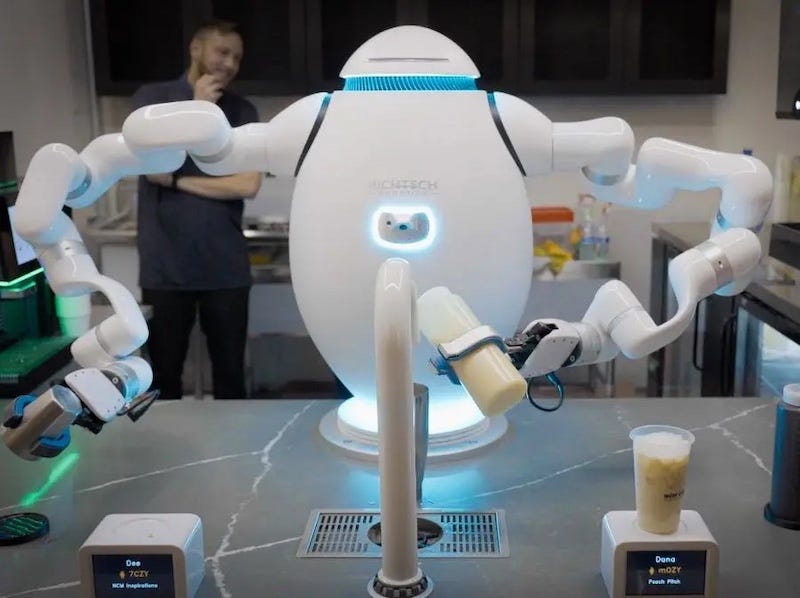
Richtech Robotics puts its ADAM robot on a 24/7 livestream and wants people to talk to it, ask it to do things, and get comfortable with the idea of robots in public life
There is a trust problem in robotics that no spec sheet can solve. People are not sure how to feel about robots operating around them and most of the industry’s answer has been controlled demos, trade show appearances, and polished videos. Richtech Robotics is trying something different. The company has put ADAM, its dual-armed service robot, on a round-the-clock interactive livestream where anyone in the world can chat with it, ask questions, and watch how it responds in real time. Not pre-recorded. Not scripted. Live, continuous, and open to the public.
COO Phil Zheng put the logic bluntly: most robots are still off limits or handing out popcorn. Richtech wants people to be able to ask the robot to do things. The company is calling ADAM one of the first robot “influencers,” which sounds like marketing until you consider what it actually means operationally. Running a robot on a 24/7 public-facing stream with real-time interaction is a stress test for conversational AI, embodied response, and failure recovery that no internal QA process can replicate. Every awkward pause, missed instruction, and unexpected question becomes training data in front of an audience.
ADAM already has a deployment history that extends well beyond the lab. The robot served drinks at Kennedy Space Center last year, prepared noodles live at the National Restaurant Association show last month, and was recently installed as a barista in Times Square where its first coffee reportedly went to Shaquille O’Neal. The hardware runs on Nvidia’s Isaac platform with Jetson Thor for onboard compute. Richtech has also been expanding its commercial infrastructure aggressively through 2026, acquiring a 79,000 square foot warehouse in Las Vegas, signing a European distribution deal with Netherlands-based NewConsultancy, listing its robotic systems and data services on Microsoft’s Azure Marketplace, and preparing to show its industrial humanoid Dex and a new AI-driven pallet jack at Automate in Chicago next week.
What makes the livestream initiative worth watching beyond the novelty is what it says about where the human-robot interaction bottleneck actually sits. The hardware is getting good enough. The manipulation is improving. The perception stack works in more environments than it did two years ago. But public comfort with autonomous robots in shared spaces remains low, and that is a deployment barrier that technical performance alone will not clear. Richtech is betting that familiarity breeds trust, and that putting a robot in front of an open audience every hour of every day is a faster path to that familiarity than any number of curated demo reels. Whether ADAM can hold up under that level of continuous public scrutiny is the experiment. The answer will show up live, whether Richtech likes the result or not.