
The Netherlands just opened its first innovation centre dedicated to putting humanoid robots to work, and construction is the first use case on the floor
Europe has a problem with humanoid robotics that has nothing to do with the robots themselves. The hardware is advancing globally, billions are flowing into development, and new platforms are shipping from China and the US on a near-weekly basis. What Europe lacks is the infrastructure and practical expertise to actually deploy these machines inside real businesses. The Humanoid Application Centre, which opened this week at the Mechatronics Innovation Campus in Schiedam near Rotterdam, is a direct attempt to close that gap.
The HAC is not a showroom. It is structured as a working facility where businesses, technology partners, educational institutions, and public authorities can test humanoid robots under realistic conditions before committing to deployment. The founding consortium tells you where the early demand is coming from: Dura Vermeer and VolkerWessels from construction, Harvest House from greenhouse horticulture, GOM from facilities management, and Eurocaps from capsule manufacturing. These are companies dealing with labour shortages, physically demanding repetitive work, and ageing workforces right now, not in five years.
Dura Vermeer is already running its first use case, exploring how humanoid robots can support paving work on infrastructure projects. Director of Technology Jaap Hulshoff framed the logic plainly: the construction sector cannot wait until humanoid technology is fully mature to start learning how it integrates with existing workflows, because by the time it is mature the companies that started early will have a significant operational advantage over those that did not. Other sectors being explored inside the HAC include logistics, industrial inspection, healthcare support, and greenhouse horticulture, where bell pepper harvesting is one of the specific applications under testing.
The HAC also runs demonstrations, training programmes, and implementation tracks for organisations at different stages of readiness, and collaborates with educational institutions from vocational colleges through to universities so students can work with the hardware directly. Co-founder Evert Jaap Lugt made the point that the challenge in humanoid robotics has shifted from building the robots to integrating them into existing business processes, and that is a fundamentally different kind of problem that requires a different kind of facility to solve. Whether the HAC becomes the anchor of a broader European humanoid deployment ecosystem or remains a single national initiative depends on whether the pilot results from its founding partners translate into repeatable playbooks that other industries and countries can adopt.
Sonair’s ADAR One becomes the first ultrasonic sensor to earn SIL2 and PLd safety certification and the standards bodies had to rewrite their tests to make it happen
Here is the thing about robot safety that most people do not think about.
Almost every autonomous mobile robot navigating a warehouse or factory floor right now sees the world as a single horizontal line. One scan, one height, usually around your shins. A 2D laser scanner catches your legs. It misses everything else. Your arm reaching toward the robot, a shelf hanging overhead, a cable dangling from the ceiling. All invisible. The workaround is crude: widen the safety buffer, slow the robot down, accept the throughput loss. It works. It is also why a lot of AMR deployments run slower than they should.
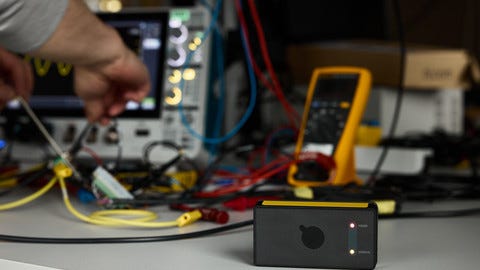
Sonair, an Oslo-based company, just got its ADAR One sensor certified to SIL2 and Performance Level d, making it the first ultrasonic sensor to meet international safety standards for human protection around machines. That sentence sounds routine until you learn what it actually took.
The standards were not built for this. IEC 61496, the framework for protective sensors, was written around optical devices like light curtains and laser scanners. Detection capability is defined in optical terms, physical test pieces of a given diameter that the sensor must reliably spot. None of that applies to sound. Sonair had to map an entirely different physics onto an existing safety framework, prove detection capability acoustically, and document the reasoning thoroughly enough to survive assessment by exida in Germany. They leaned on IEC 62998, a newer technology-agnostic standard designed to accommodate sensing modalities that did not exist when the original standards were drafted.
The certification consumed the company. CEO Knut Sandven said they paused all other development, worked through nights, weekends, and holidays, and produced a documentation package running to thousands of pages. Earning the certificate is not just about hitting a hardware metric. The system has to prove it can detect its own faults and fail safely when it no longer trusts its own readings. Then comes the lifecycle evidence, the failure mode analysis, and the validation testing.
What ADAR One actually does: 180 by 180 degree 3D spatial awareness using ultrasound, detecting people and objects at all heights, not just one horizontal slice. Probability of dangerous failure sits below 1.5 x 10^-7 per hour. It ships now, already in series production on deployed industrial robots.
Where it fits is broad, but a few applications stand out. AMRs and AGVs in shared human spaces are the obvious starting point. Robotic arms where removing the safety fence has real value. And humanoids, where the transducer array is compact enough to embed directly inside the body shell, complementing cameras rather than duplicating them by covering conditions where dust, glare, glass, and low light degrade vision. Sonair sees ADAR as a platform, not a single product, with the next generation focused on smaller form factors and lower cost as volume scales.
Also worth noting: ADAR One is the first safety-certified embedded system built in Rust.
InDro Robotics releases Cortex, a 679-gram compute box that turns any robot or drone into a 5G-connected, ROS2-ready platform in minutes
Building a robot from scratch is one problem. Making an existing robot smarter without rebuilding it is a different one, and often harder in practice because the integration work eats more time and budget than the hardware itself.
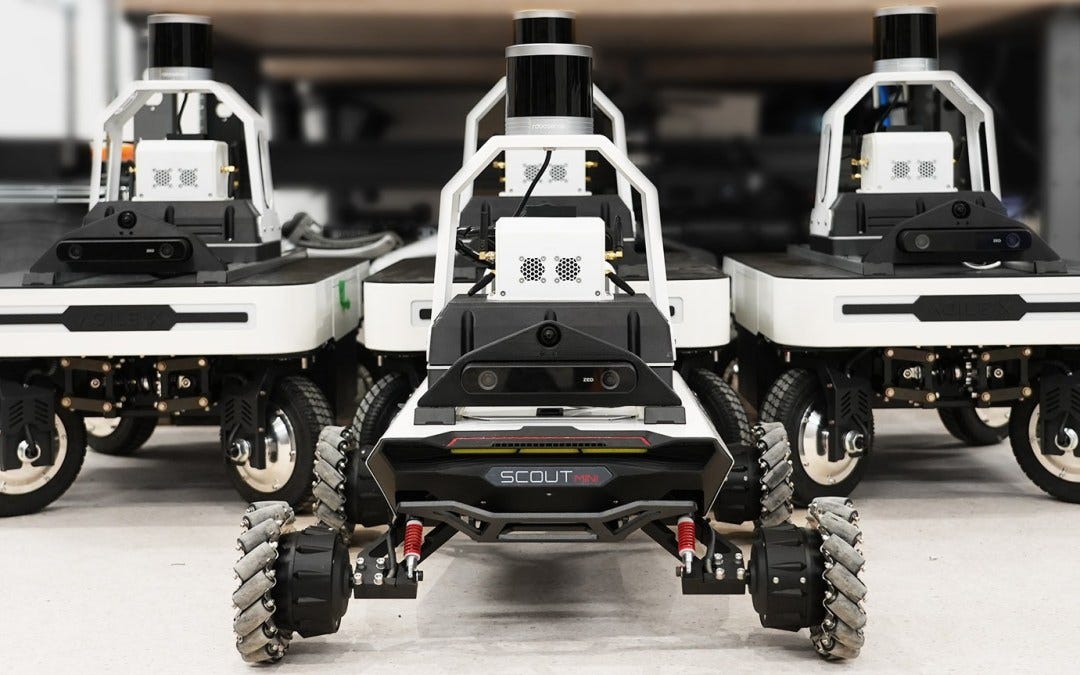
InDro Robotics, a Canadian company, is shipping Cortex and Controller as a paired hardware-software solution aimed squarely at that second problem. Cortex is a platform-agnostic compute and sensor integrator that mounts onto any ground robot or specialized drone. It measures 11cm by 14cm by 10cm, weighs 679 grams, ships preloaded with ROS2 Humble on Ubuntu 22.04 LTS, and includes a 5G modem with long-range antennae for teleoperation with near-zero lag on public or private networks, with WiFi as a fallback. The base processor runs at 100 TOPS, upgradeable for higher-demand applications. Power for connected sensors comes directly from Cortex, which draws from the platform itself. Multiple I/O and power options handle the sensor integration side, and because it ships with all the ROS2 libraries, drivers, and communication protocols preloaded, InDro says connecting new sensors is close to immediate rather than a multi-day configuration exercise.
Controller is the software layer that makes sense of everything Cortex processes. It runs directly onboard the hardware, accessible through a secure encrypted browser login tied to your specific robot. The dashboard supports three operation modes: manual teleoperation, autonomous waypoint navigation, and GPS-denied navigation using LiDAR SLAM or visual SLAM. Operators can run multiple sensor feeds simultaneously, resize and arrange data windows, program site-specific tasks like PTZ camera zoom on points of interest, and save unlimited missions that run automatically on set schedules.
The target market spans a wide range, from academic research labs that need to get a robot operational quickly without months of integration work, to defense platforms where secure 5G connectivity and autonomous navigation in GPS-denied environments are operational requirements rather than nice-to-have features. InDro founder Philip Reece said several years of R&D at the company’s Area X.O engineering facility went into building Cortex, and that both Cortex and Controller will be core products for the company going forward.