
Robotics just became the second largest category in private markets. Here's everything for the week!
#11
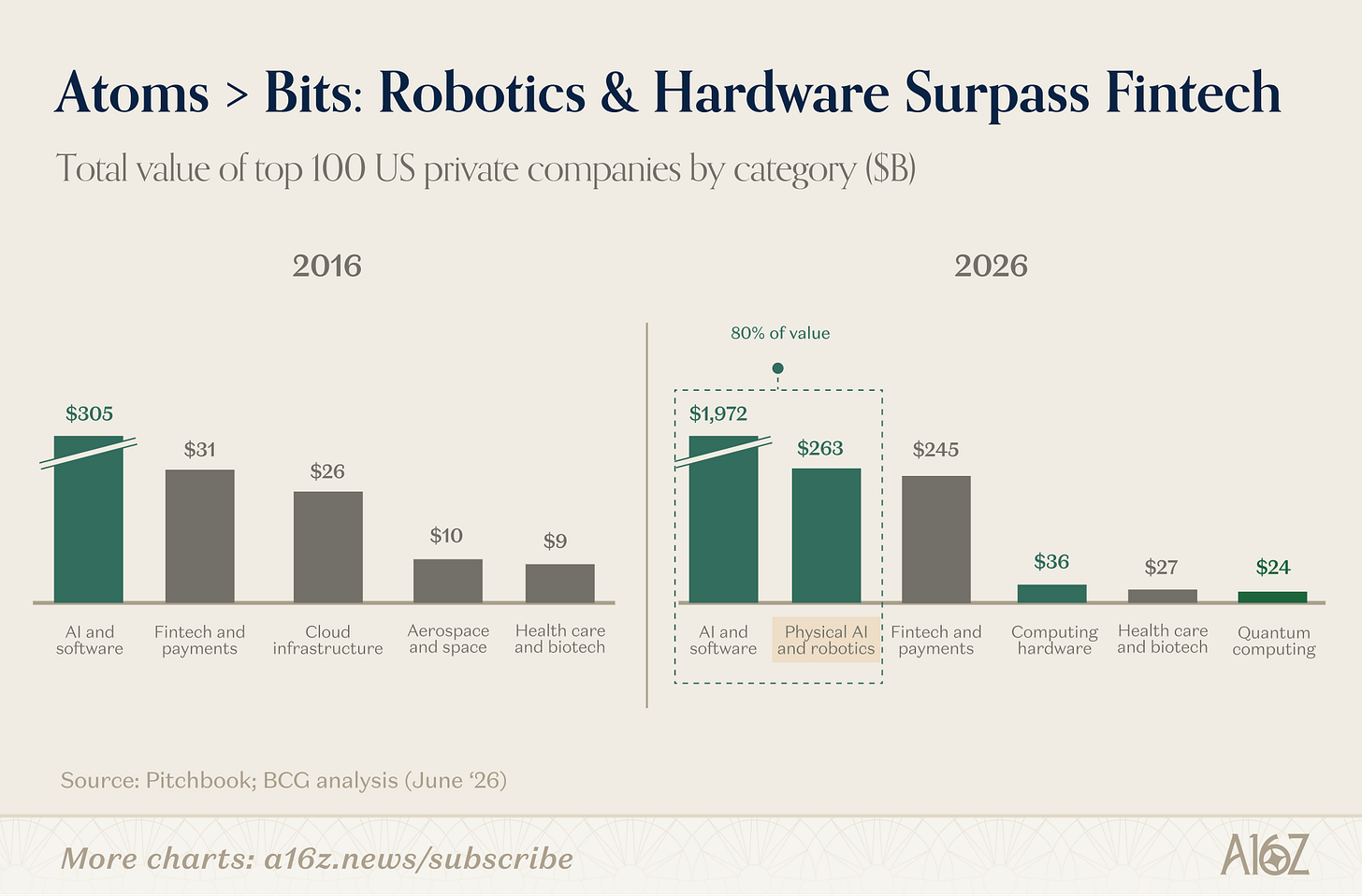
Robotics wasn't even on the chart in 2016. It is now the second largest category in private markets, ahead of fintech.
a16z published a piece this week that deserves more attention than it got. Buried inside a broader analysis of market cycles and capital rotation is a data point that reframes how seriously the investment world is now taking physical AI and robotics. Measured by the aggregate value of the top 100 private companies by category, robotics and physical AI did not register as a category a decade ago. As of 2026, it has overtaken fintech and payments to become the second largest segment, trailing only AI and data infrastructure.
That is not a gradual climb. That is a category that went from invisible to dominant in under ten years.
The deal flow data from PitchBook backs it up. Q1 2026 set a record for robotics and physical AI on both deal value and deal count, with approximately $16 billion invested across just under 500 deals. To put that in context:
Deal count is roughly 2x the average from the 2021 to 2025 stretch
Deal value is approximately 4.5x larger than the same period
This is not a blip driven by one or two mega-rounds. Nearly 500 separate transactions closed in a single quarter, which means capital is spreading across the category at every stage, from seed through late-stage growth.
a16z frames this inside a broader thesis they have been building for a while: the market is rotating from bits to atoms. The post-pandemic investment cycle has flipped the script on what worked after the global financial crisis. Back then, capital-light, consumer-oriented sectors like healthcare, media, and consumer products delivered double-digit returns. Those same categories are now doing low single digits. Meanwhile, energy, raw materials, construction, and financials, all of which lagged in the 2010s, have moved into the mid-to-high double digits. Asset-heavy companies have overtaken asset-light companies after trailing for an entire decade.
Tech remains the exception as a repeat winner across both cycles, but there is a split happening within tech itself. Hardware is the real standout of the current cycle. Software, which dominated the last one, has actually followed the broader pattern of inversion and cooled off. That distinction matters because the robotics surge is not a software story. It is a hardware story, enabled by software, but grounded in physical machines doing physical work.
The a16z piece draws a comparison to electrification that is worth sitting with. When factories first got access to electric power, most manufacturers simply swapped out the steam engine for a large electric motor and kept everything else the same. The shafts, the belts, the floor layout, all unchanged. Productivity barely moved. The real gains only arrived when manufacturers realized they could put smaller motors at each individual machine and redesign the entire factory around distributed power. That was not an incremental improvement. It was a complete architectural rethink that unlocked one of the largest productivity leaps in industrial history.
The parallel to robotics and AI is direct. Most companies today are still in the “swap the motor” phase, applying AI to existing processes without rethinking the process itself. a16z cites a study of 515 high-growth startups that found firms who redesigned their workflows around AI, rather than just inserting AI into existing steps, discovered 44 percent more use cases, generated roughly double the revenue at the top end, and consumed 40 percent less capital. The productivity gains are real, but they live downstream of a discovery problem that most organizations have not yet solved.
For robotics specifically, the implication is that the current wave of investment is not just about building better robots. It is about building the infrastructure layer for a physical economy that gets redesigned around what AI-enabled machines can do, rather than slotting robots into workflows that were built for human hands and human judgment. Defense is the highest-profile frontier right now, and expanding global defense budgets are pulling capital into autonomous systems at an accelerating rate. But the a16z thesis suggests the rotation to atoms may be deeper, wider, and longer than any previous modern tech cycle, extending well beyond defense into manufacturing, logistics, energy, agriculture, construction, and eventually domestic environments.
The bottom line from this data is straightforward. Robotics is no longer a niche category sitting at the margins of venture capital. It is now the second largest concentration of private market value on the planet after AI infrastructure, and the rate at which capital is entering the space has no historical precedent. Whether this cycle produces lasting companies or an overheated correction depends on whether the firms absorbing this capital can convert it into deployed systems that generate revenue, not just prototypes that generate excitement. But the capital allocation signal is no longer ambiguous. The money has decided that the next decade belongs to machines that operate in the physical world.
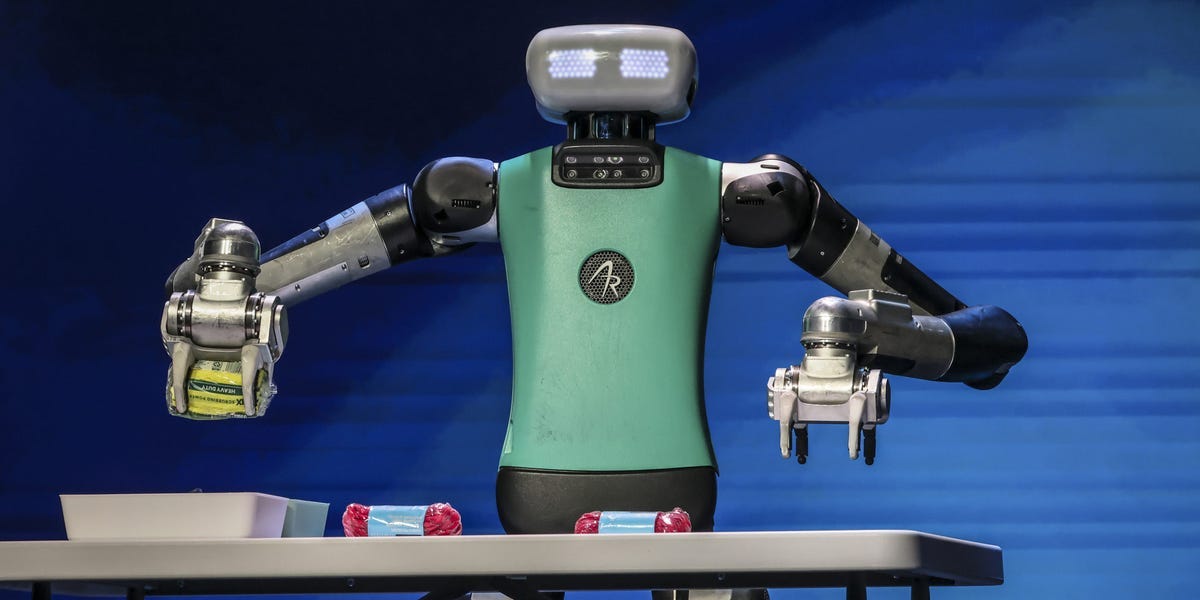
Agility Robotics is going public through a SPAC at a $2.5 billion valuation, the first pure-play humanoid company to list on Wall Street
The robot that just earned a $2.5 billion valuation and a ticket to Wall Street does not have a face. Its legs bend backward like a bird. Its hands are grippers, not fingers. Agility Robotics co-founder Jonathan Hurst told investors the company never set out to build a machine that looks like a person. They built one that carries heavy totes in warehouses, and that turned out to be enough.
Agility announced the listing at Automate in Chicago through a planned merger with Churchill Capital Group’s SPAC, making it the first publicly traded company entirely devoted to building and selling humanoid robots. Amazon, Nvidia, SoftBank, and Foxconn are all on the cap table. Toyota, Schaeffler, and Mercado Libre are among the early customers already running Digit in their operations.
The thesis is straightforward and CEO Peggy Johnson did not dress it up. Companies are reshoring production. Older workers are leaving manual roles and not being replaced. Younger workers are opting out of repetitive, physically demanding jobs entirely. Digit exists to fill the gap that those three trends are creating inside warehouses and manufacturing facilities, not to be a general-purpose platform that does everything. It carries totes. It moves bins. It does the work that is dirty, repetitive, and injury-prone. Johnson called the demand large and increasing.
What Agility is not doing is also worth noting. No dancing demos. No backflip videos. No kitchen tasks or needle threading. The company has deliberately narrowed its identity to a “worker bee” robot, which stands in sharp contrast to Unitree, the Chinese humanoid company that recently filed for its own IPO on the Shanghai Stock Exchange and regularly leads with athletic spectacle. Aaron Prather from the Association for Advancing Automation pointed out the divergence at the trade show, noting that the market is wide open enough for both approaches to find their footing without one needing to be wrong for the other to work.
Proceeds from the SPAC merger will go toward scaling commercial deployments and producing Digit V5, the fifth generation of a bipedal robot line that started nearly a decade ago inside a lab at Oregon State University. Longer-term, Agility expects future Digit versions to work directly alongside humans rather than in fenced-off zones, with eventual expansion into hospitality, home services, and elder care. The company is projecting a trillion-dollar-plus addressable market for the category. Whether public market investors share that conviction at a $2.5 billion entry price is the question the listing will answer.

Agility Robotics is going public through a SPAC at a $2.5 billion valuation, the first pure-play humanoid company to list on Wall Street
This one caught me off guard. General Intuition is training physical AI models not on robot demonstrations, not on simulation data, but on billions of gaming clips that people uploaded to Medal, a platform where gamers share their gameplay moments. The company’s CEO, Pim de Witte, also co-founded Medal, which is how this whole thing started.
It sounds odd until you think about what a gaming clip actually contains. A human is looking at a 3D environment, reading what is happening around them, deciding where to move, and executing that decision in real time. Every clip comes with embedded action labels recording exactly which button was pressed and when, so you get a clean mapping between what the player saw, what they chose to do, and what happened next. That is closer to how physical AI needs to think than anything you can get from text descriptions or scripted robot demos. And the scale is hard to compete with. Nobody else in the space has access to billions of action-labeled clips across thousands of different environments, and the dataset keeps growing on its own every time someone posts to Medal.
General Catalyst led the $320 million round. Jeff Bezos and former Google CEO Eric Schmidt also participated. Total funding is now $454 million, with the company valued at $2.3 billion. What surprised me is that General Intuition has actually been around since 2015, quietly building two model types: action models that decide what to do, and world models that predict what happens after. The funding goes toward scaling compute and pretraining the next model version, with a public API expected this summer.
The open question is obvious. Gaming environments are rich and diverse, but they are still not the real world. Friction, weight, material compliance, lighting conditions, none of that translates perfectly from a rendered game engine to a physical robot handling objects on a factory floor. General Intuition’s bet is that the perception and decision-making patterns transfer even if the physics do not match exactly, and that the sheer volume and diversity of the data compensates for the domain gap. Whether that holds up when the models start driving real hardware is something the company has not yet demonstrated publicly. But the approach is genuinely novel, the data moat is real, and the investor confidence at this valuation suggests people closer to the technology believe the thesis has legs.
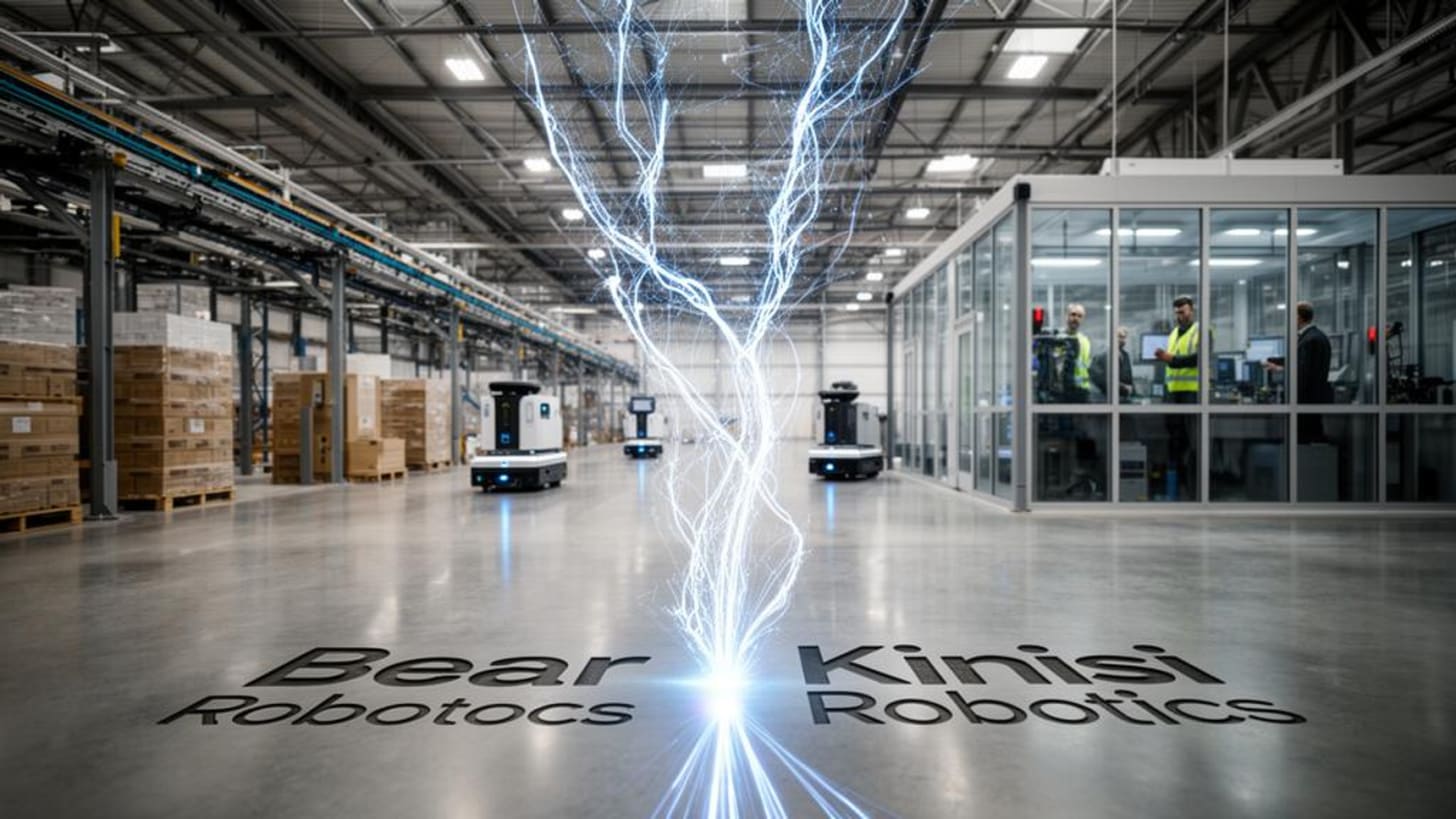
Bear Robotics signs agreement to acquire Kinisi Robotics, adding humanoid manipulation to a fleet of 16,000 deployed service robots
Bear Robotics has been shipping robots since 2017. Over 16,000 units in commercial service worldwide, running delivery and cleaning tasks across hospitality, logistics, and enterprise environments. All on one platform, one cloud orchestration stack, one manufacturing supply chain. What Bear has not had until now is a robot that can actually handle objects.
That is what Kinisi brings. The Bristol-based company built the KR1, a wheeled humanoid platform designed for picking, placing, sorting, and moving objects. Kinisi’s manipulation stack includes a vision-language-action model and a robot foundation model built on imitation learning, reinforcement learning, agentic task control, and computer vision. The company also developed its own gripper hardware and a low-cost data capture glove that lets human operators record manipulation demonstrations by hand, decoupling training data collection from robot uptime.
The connection between the two companies is not new. Kinisi was built on Bear’s production navigation stack from day one. Bear’s fleet data fed into Kinisi’s development, and Bear had direct visibility into the quality of Kinisi’s engineering throughout. Kinisi founder Brennand Pierce is also a Bear co-founder who left to start Kinisi and will rejoin as Chief Robotics Officer once the deal closes. This is less an acquisition of a stranger and more a reunion with extra capability attached.
The commercial logic is clean. Bear already has robots deployed, customers paying, and a manufacturing pipeline producing at scale. Most humanoid companies are still working to get from pilot to product. Bear is already past that stage and is now adding manipulation as a new layer on top of an operational fleet rather than building from zero. The same robots that currently navigate and deliver can, with Kinisi’s technology integrated, begin picking, sorting, and handling physical work across the same sites they already operate in. One platform, multiple robot types, coordinated as a single team rather than a patchwork of vendors.
Kinisi’s Bristol office stays as a strategic engineering hub. Existing customer relationships on both sides continue unchanged until the transaction closes, which is expected in the coming days.