
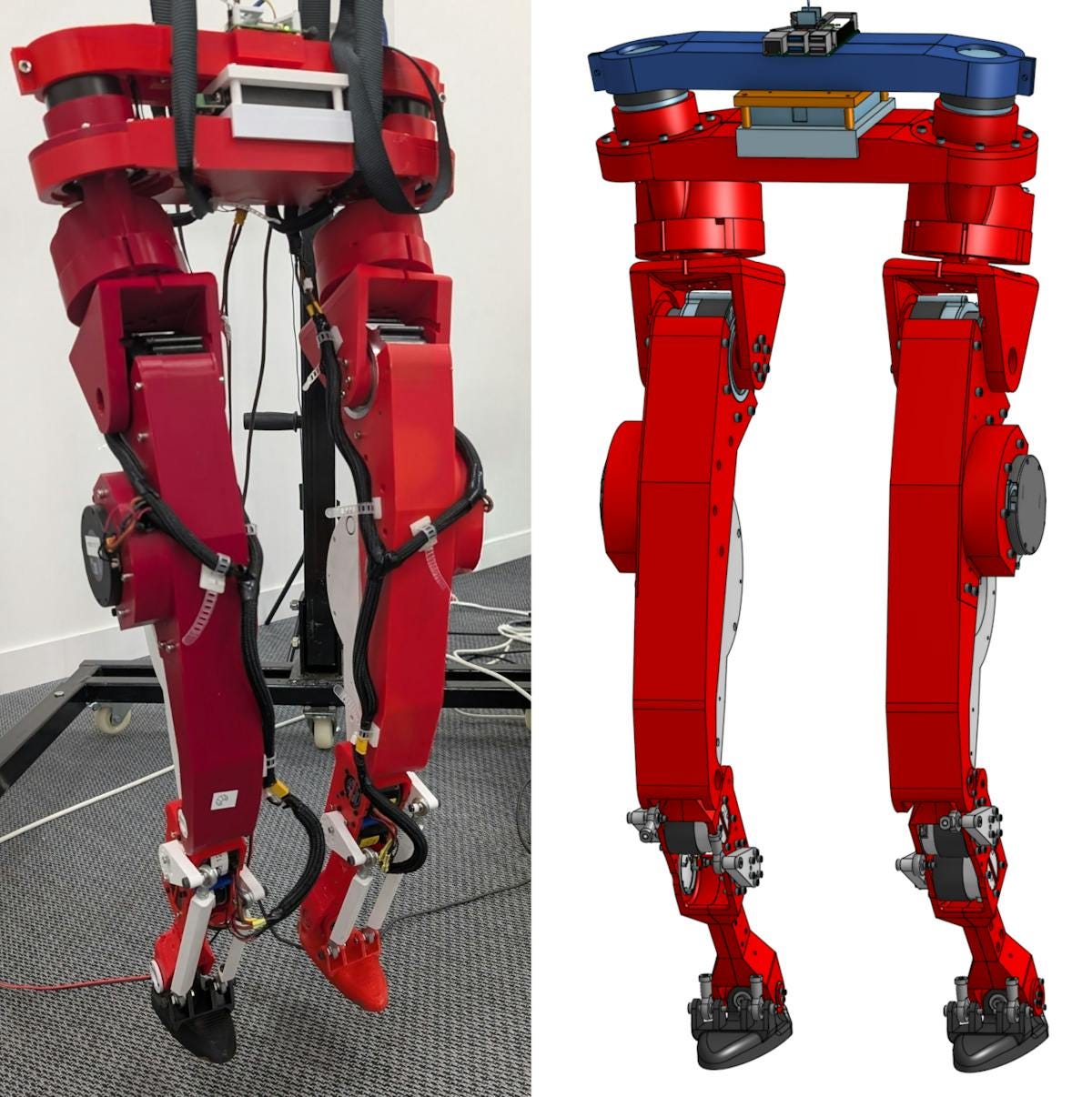
Hugging Face releases LeRobot Humanoid, a $2,500 open-source bipedal platform designed to close the gap between simulation and real-world robotics
Hugging Face has released LeRobot Humanoid, an open-source, 3D-printed bipedal robot built for researchers, students, and hobbyists who want a humanoid platform they can assemble, break, modify, and actually understand from the ground up. The current version is a lower-body locomotion platform rather than a full humanoid, focused on standing and walking rather than manipulation tasks. At roughly $2,500 in total cost, it is far from cheap in absolute terms, but in a field where capable humanoid robots routinely cost more than a car, the price point opens the door to a significantly wider pool of builders than any comparable platform on the market.
The hardware is constructed from 3D-printed structural parts combined with off-the-shelf electronics and affordable actuators, a design choice made specifically to maximize reproducibility and iteration speed. If a part breaks, it gets reprinted. If a design decision turns out to be wrong, builders can revise and test a new version without waiting on custom manufacturing. Hugging Face has released more than just the hardware files. The project ships with assembly instructions, wiring diagrams, simulation tools, calibration utilities, identification pipelines, and machine learning training environments, all organized across separate repositories covering mechanical and control co-design, runtime deployment, robot model assets, and simulation-based parameter identification.
The deeper problem LeRobot Humanoid is built to address is one of the most persistent gaps in robotics development. Locomotion policies trained in simulation consistently fail when transferred to real hardware, because the physical world introduces friction, latency, weight distribution, and surface conditions that simulation environments approximate but rarely capture accurately. LeRobot Humanoid connects the design tools, simulation environments, real-world data collection, and parameter identification systems into a single continuous workflow, which means researchers can iterate across the full pipeline without switching between disconnected toolchains. Training environments are included through a dedicated repository called lerobot-legged-zoo, where users can develop and evaluate locomotion policies in simulation before running them on actual hardware. For now, this remains an experimental research platform rather than anything approaching a consumer product. But the contribution is less about what LeRobot Humanoid can do today and more about what it enables. Making humanoid robotics cheaper, fully open, and reproducible at this level of completeness lowers the entry barrier for the kind of broad-based experimentation that has historically been locked behind lab budgets and institutional access.

Waymo pauses freeway operations across multiple U.S. markets after a 3,800-vehicle recall over flooding detection and construction zone performance issues
Waymo has temporarily halted all freeway operations for its robotaxi service across multiple U.S. markets while the company works on software updates to improve how its vehicles handle construction zones and flooded roadways. Surface street operations remain active and unaffected. The company said its vehicles navigate construction zones more than 10,000 times per day, which gives a sense of the scale at which even a marginal performance gap compounds into a meaningful safety concern on high-speed roads where reaction margins are tighter.
The freeway pause follows a series of incidents that escalated quickly over the past several weeks. Flash flooding in Atlanta forced a separate operational pause after multiple Waymo vehicles encountered floodwater, with at least one requiring physical recovery. That led to a recall filed with NHTSA covering 3,791 vehicles equipped with fifth- and sixth-generation Automated Driving Systems. The specific defect, as described by NHTSA, is that when a Waymo vehicle detects standing water on a higher-speed road, it may slow down but fail to fully stop after recognizing the hazard. The regulator estimated the defect rate at 100 percent across the recalled fleet. The triggering incident occurred on April 20, when an unoccupied Waymo vehicle detected a flooded section of a 40 mph roadway and continued through it at reduced speed rather than stopping entirely.
Waymo applied an interim fix to all affected vehicles on the same day, restricting the approved operating scope of its ADS to exclude conditions with elevated flood risk on higher-speed roads. A final remedy is still in development. The broader picture here is that Waymo operates thousands of vehicles across San Francisco, Los Angeles, Phoenix, and Austin, and the company has been expanding aggressively into new markets including Chicago. Construction zones and extreme weather are two of the most persistent edge cases in autonomous driving, and both are conditions where the gap between surface street performance and freeway performance becomes most apparent. The pause is a deliberate and conservative response, but it also highlights that even the most mature autonomous driving program in the world is still working through the long tail of real-world conditions that controlled testing environments do not fully prepare a system for.

EngineAI opens a 12,000 square meter humanoid manufacturing base in Shenzhen, producing one robot every 15 minutes with a 10,000-unit annual delivery target
EngineAI Robotics has launched its Intelligent Manufacturing Base in Honghualing, Shenzhen, alongside the first batch rollout of its flagship T800 full-size humanoid robot. The facility spans approximately 12,000 square meters and runs a closed-loop manufacturing process from incoming material inspection through component assembly, final assembly, end-of-line testing, shipment, and after-sales maintenance. The headline production number is one completed humanoid robot every 15 minutes, which at sustained throughput puts the facility’s capacity at the 10,000-unit annual target the company has committed to.
The manufacturing timeline EngineAI is presenting moves fast. The company went from its first test machine in 2024 to small-scale production of several hundred PM01 units in 2025, and is now claiming a qualitative jump toward large-scale delivery capability within a purpose-built facility. Founder and CEO Zhao Tongyang framed the transition as moving from pilot production to mass manufacturing, with a production system built around quality, efficiency, and intelligent manufacturing. Each robot leaving the line passes through 79 full-dimensional quality inspections and 46 working condition simulation tests before delivery, which is a rigorous validation pipeline by current humanoid industry standards. Automated locking, gluing, and laser welding systems have reportedly increased production efficiency by 40 percent, and a digital management system provides full traceability so that every component and finished robot carries a unique production identity across the entire value chain.
EngineAI is also building out manufacturing capacity beyond Shenzhen, with facilities planned across Henan and other regions. Co-founder Ren Guowen described the multi-site layout as a way to allocate capacity more flexibly and respond faster to market demand, positioning the network as the foundation for global expansion. The broader context here is that the race to scale humanoid manufacturing in China has intensified significantly through 2026, with Unitree, Robotera, UBTech, and AGIBOT all pushing toward or past volume production milestones within the same window. EngineAI’s Shenzhen facility and its 15-minute cycle time put the company in that conversation, though whether the T800 finds the same commercial traction as competitors already operating inside logistics and industrial environments is what the next few quarters will answer.
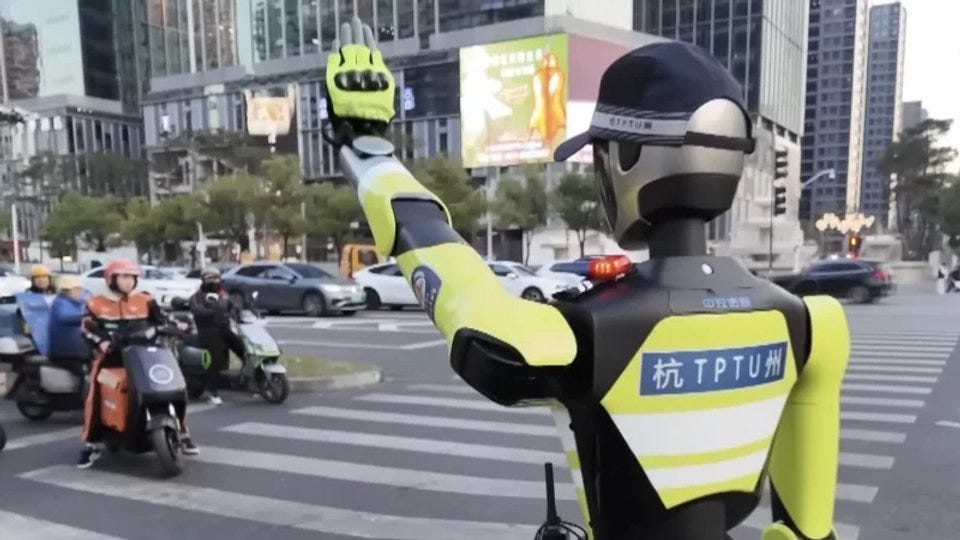
China assigns digital identity codes to every humanoid robot manufactured in the country, with over 28,000 units already registered and a strict no-code-no-market-access policy in effect
China has launched a national identification system for humanoid robots that assigns every unit a unique 29-digit code, effectively creating a digital passport that follows the machine from the factory floor through deployment, maintenance, and eventual disposal. The initiative, called the Humanoid Full Lifecycle Management Service Platform, is overseen by the Ministry of Industry and Information Technology through its Humanoid Robotics and Embodied Intelligence Standardization Committee. More than 100 Chinese humanoid manufacturers have already joined the platform, with over 28,000 robots across 200 different models registered to date.
The 29-digit identification code breaks down into four components: a two-digit country code, a four-digit manufacturer code, a six-digit product model code, and a 17-digit serial number unique to each individual robot. Together, these create a traceable identity that records who manufactured the robot, what model it is, where it has been deployed, its full maintenance history, and what happens to it at end of life. The system applies across the entire ecosystem, covering manufacturers, sellers, service providers, end users, and recycling companies, which means every entity that touches a humanoid robot at any stage will interact with the same identification framework.
The regulatory teeth behind this are worth noting. China has implemented a “no code, no market access” policy, meaning no humanoid robot can be sold or deployed domestically without first being registered in the system. Manufacturers are required to issue recalls if common defects are identified across registered units. Refurbished robots assembled from scrapped parts are explicitly barred from re-entering the market. These are not voluntary guidelines. They are conditions of market participation, which gives the Chinese government a level of traceability and enforcement over its humanoid robotics sector that does not currently exist in any other country.
The timing of this rollout matters. China’s humanoid manufacturing sector has scaled rapidly through 2025 and 2026, with companies like Unitree, Robotera, UBTech, AGIBOT, and EngineAI all pushing toward or past volume production. As these companies move from hundreds of units to thousands and eventually tens of thousands, the questions around safety accountability, defect tracking, and lifecycle management become operational problems rather than hypothetical ones. A centralized identity system at this stage gives regulators a structural tool to manage that growth before it outpaces oversight, rather than retrofitting governance after incidents have already occurred. No comparable framework is currently in development in the United States or Europe.