
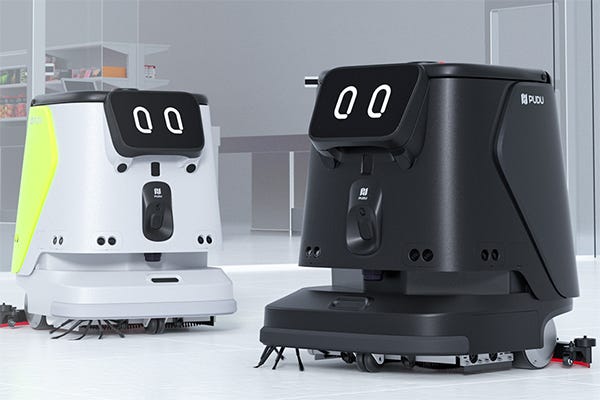
Pudu Robotics closes $150M at $1.5B valuation as Chinese state and industrial capital replace traditional VC!
Pudu Robotics, the Shenzhen-based commercial service robotics company, has closed a new funding round of nearly $150 million at a post-money valuation above $1.5 billion, bringing its cumulative funding to over $300 million. While the English-language announcement did not name the investors, Chinese financial media including Pedaily, Securities Times, and Ifeng Tech reported the round was co-led by Longgang Financial Holding, the state-owned financial arm of Shenzhen’s Longgang District government, along with Ya Capital. Participating investors include BAIC Industrial Investment, the investment arm of state-owned automaker BAIC, Shenzhen-listed precision manufacturing giant Lens Technology, Highlight Capital, and multiple government guidance funds from the Pearl River Delta and Yangtze River Delta regions. Pudu plans to use the capital to accelerate embodied AI development, expand its product portfolio, scale manufacturing, and deepen its global footprint across retail, hospitality, industrial, and healthcare sectors.
What makes this round worth paying attention to is how different the investor mix looks compared to Pudu’s earlier fundraises. Previous rounds between 2020 and 2021 were led by classic growth-stage tech investors including Sequoia Capital China, Tencent, and Meituan, with Sequoia leading the Series B+ and Tencent anchoring the Series C1. The 2026 round has no Western or independent VC participation, and is instead dominated by district-level state holdings, industrial strategics, and government guidance funds. This reflects a broader pattern taking shape across Chinese robotics financing, where Beijing’s designation of embodied AI as a national priority, along with a reported $138 billion innovation fund announced in March 2025, has pulled state and industrial capital into the center of the cap table. Lens Technology’s participation is particularly notable given its growing role as a hardware platform for humanoid robot programs at AgiBot, Honor, and Dobot, which positions Pudu inside a coordinated supply chain rather than as a standalone portfolio bet.
The round also lands against the backdrop of a genuine operational turnaround at Pudu. The company nearly collapsed in 2022, cutting headcount from roughly 3,000 to around 500 and issuing a widely leaked letter from Felix Zhang about surviving the “long winter.” What pulled it back was a product mix shift toward commercial cleaning, which now accounts for over 70 percent of revenue, along with a new industrial delivery line that shipped more than 4,000 units in its first year. Pudu reported 100 percent year-over-year revenue growth in 2025 with EBITDA approaching break-even, and its cumulative shipments have crossed 120,000 units across 80-plus countries, serving customers including Carrefour, Walmart, and EDEKA. The company was restructured into a joint-stock company in 2025, a standard step for Chinese firms preparing for a public listing, and Chinese coverage of the round explicitly describes the proceeds as laying the groundwork for a future IPO. Competitive context matters here as well, with Keenon Robotics and OrionStar having lost fundraising momentum, leaving Pudu as the clearest pre-IPO candidate in China’s commercial service robotics space.

Glydways raises an oversubscribed $170M Series C to build autonomous pod networks, with pilots going live this year!
Glydways, the San Francisco-based urban mobility company, has closed a $170 million Series C funding round co-led by Suzuki Motor Corporation, Spanish infrastructure group ACS, and Khosla Ventures. The round also drew participation from existing investors Mitsui Chemicals and Gates Frontier, which is Bill Gates’s venture arm, along with Japanese construction major Obayashi Corporation as a new backer.
The raise, reported as oversubscribed, brings Glydways’ cumulative funding to more than $250 million at a valuation of roughly $700 million, according to Bloomberg. TechCrunch reported that the company is already in discussions for a follow-on $250 million round that could push its valuation past the $1 billion mark. Glydways plans to use the capital to scale production of its next-generation vehicles through its Suzuki partnership, grow headcount from 270 employees toward double that in the next two years, and expand its global footprint across North America, Asia Pacific, the Middle East, and Europe.
What sets Glydways apart from the broader autonomous mobility field is that it operates on a closed-infrastructure model rather than competing on open roads with players like Waymo, Zoox, and Tesla. The company’s system pairs small electric pods called Glydcars with dedicated guideways that are roughly two meters wide, about the width of a bike lane, which can be built at ground level or elevated. Riders hail a pod through an app and travel directly from pickup to destination without intermediate stops, with the network capable of moving up to 10,000 passengers per hour per lane at speeds of around 50 kilometers per hour. Glydways claims infrastructure costs up to 90 percent lower than traditional rail and operational expenses roughly 70 percent lower, which positions the system as a viable alternative for cities that cannot justify the capital outlay or construction timelines of heavy rail projects.
The Series C lands alongside a set of commercial milestones that move Glydways from concept into live deployment. The company has signed memoranda of understanding with the Abu Dhabi Investment Office and the Dubai Roads and Transport Authority, where several potential routes have been identified, including connections between metro stations and key destinations like Bluewaters Island and Madinat Jumeirah. In the United States, Glydways broke ground earlier this year on a half-mile pilot loop in South Metro Atlanta that will link the ATL SkyTrain at the Georgia International Convention Center to the Gateway Center Arena, with a free public test service scheduled to launch in December 2026. A third pilot is planned in the New York City area.
According to Bloomberg, Glydways currently has more than 20 active project negotiations globally, with particularly strong traction in Japan, where Suzuki, Mitsui Chemicals, and Obayashi are positioning the company as part of a broader infrastructure-led bet on autonomous transit. Founder and co-CEO Mark Seeger, a former Apple product designer who founded the company in 2016, noted that the conversation in markets like the Middle East and Asia has shifted from skepticism toward actual deployment, which is the underlying signal this round sends to the sector.
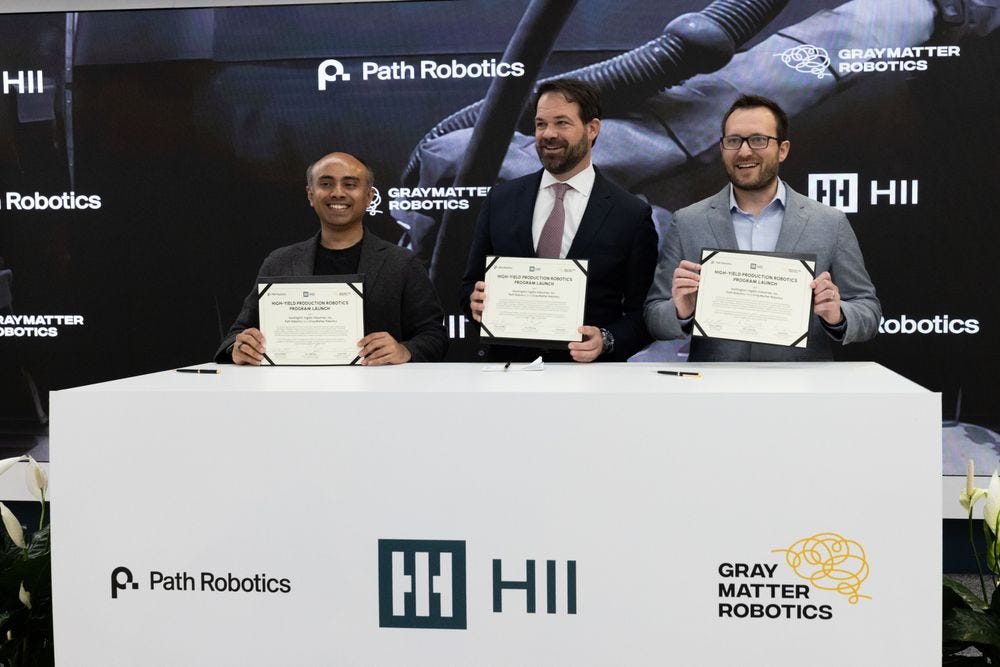
HII consolidates robotics partners under HYPR to automate naval shipbuilding!
Huntington Ingalls Industries is pulling multiple robotics capabilities under a single program called HYPR, built in collaboration with the company’s Dark Sea Labs Advanced Technology Group. The program brings together robotic welding, automated material handling, autonomous surface treatment, and autonomous quality inspection into one integrated production line aimed at improving the speed and throughput of ship and submarine construction. HII has framed the initiative as a way to apply next-generation robotics to shipbuilding tasks that have historically resisted full automation due to the complexity and variability of the work involved. Proof-of-concept demonstrations are planned for 2026, with a full pilot program expected to follow in 2027 at the company’s Newport News, Virginia facility.
Welding sits at the center of this effort, and for good reason. Path Robotics CEO Andy Lonsberry described it as the most expensive and most consequential task in the shipbuilding process, noting that while a dropped part in general assembly can simply be repositioned, a missed weld or a burn-through on a structural component can effectively scrap it. By consolidating its various automation partners into a single team, HII is betting that coordination across robotic capabilities will yield better results than deploying each system in isolation, particularly for a production environment as demanding and variable as naval shipbuilding. The broader goal is to strengthen the U.S. maritime industrial base at a time when shipbuilding capacity and workforce constraints remain persistent challenges.